Vehicle Search Engine

Custom Search

Sunday, June 29, 2008

BMW


Bayerische Motoren Werke AG (BMW), (English: Bavarian Motor Works) is an independent German automobile manufacturer founded in 1913. BMW is a worldwide manufacturer of high-performance and luxury automobiles and motorcycles, and is the current parent company of both the MINI and Rolls-Royce car brands.

Beginning with aircraft engines, BMW AG produced a variety of products in its early years, eventually shifting to motorcycle production in 1923 and automobiles in 1928. Since 1928, 96% of all BMW's produced still remain on the road today.The circular blue and white BMW logo does not symbolize a spinning propeller but rather represents the colours of the Bavarian National Flag, according to BMW spokesman Joerg Huebner (although the imagery did appear in post-WWI advertisements). The BMW roundel badge is believed to have been partially derived from the logo of its predecessor company Rapp Motorenwerke, while ultimately taking on the colors and checkers from the arms of Bavaria (fusilly in bend argent and azure). BMW's first significant aircraft powerplant was the outstanding BMW IIIa inline-six liquid-cooled engine of 1918, much preferred for its high-altitude performance, and among its successful WWII engine designs were included the BMW 132 and BMW 801 air-cooled radial engines, and the pioneering BMW 003 axial-flow turbojet.

BMW AG bought the British Rover Group (which at the time consisted of the Rover, Land Rover and MG marques as well as the rights to defunct marques including Austin and Morris) in 1994 and owned it for six years. By 2000, Rover was making huge losses and BMW decided to sell the combine. The MG and Rover marques were sold to the Phoenix Consortium to form MG Rover, while Land Rover was taken over by Ford. BMW, meanwhile, retained the rights to build the new MINI, which was launched in 2001.

1 Series


The 1 Series was launched globally in Fall 2004 and shares many structural, chassis, powertrain, hardware and electronic elements with the larger 3 Series. The model was started to provide a lower point of entry into the BMW range as the 3 Series moved gradually up-market. Initially launched as a 5-door hatchback, a 3-door version was also launched in July 2007. The 1 Series is priced between the MINI and the current E90 3 Series. Because the coupe is the only rear wheel drive vehicle in its class, it is somewhat considered the successor to the BMW 2002.

The 1 Series coupe and convertible went on sale in the United States in model year 2008 as the 128i and the 135i. The convertible, unlike the 3 Series convertible, uses a soft-top instead of a folding hardtop. This is lighter, cheaper to manufacture and preserves more trunk space than the folding hardtop would allow.

3 Series


The BMW 3 Series is a compact executive car manufactured since model year 1975. The 3 Series is currently in its fifth generation, the E90 Current models include the sport sedan (E90), station wagon (E91), coupe (E92), and convertible (E93).

The 3 series is one of BMW's most important models, as it accounts for a majority of its worldwide sales

Friday, June 27, 2008

5 Series


A mid-size executive car. For model year 2008, BMW has revised the 5 Series with a slightly redesigned interior, subtle exterior details, and new motor options.


  • The M5 is the Motorsport division's version of the 5 Series. The new M5 (built on the E60 5 series chassis) is powered by a F1-inspired V10 engine, producing 507 hp (378 kW) and is mated with a 7-speed sequential manual gearbox (SMG) transmission, which is capable of a top speed of about 330 km/h (production variants are restricted to 250 km/h, or 155 mph). BMW has also recently added a 6-speed manual transmission for 2007 and newer models.

6 Series


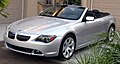
The 6 Series is BMW's
grand touring luxury sport coupe, based on the 5 Series' platform. Currently available as the 650i in coupe and convertible models in the U.S., the 6 Series returned in 2004 after a 15-year absence from BMW's model lineup.
  • M6: A high performance version of the 6 Series. Developed by BMW's M Division, it is powered by the same 5.0 L V10 507 hp (378 kW) engine seen in the BMW M5. It is currently available in Europe, North America, South America, Australia and South Africa

7 Series


BMW's full-size flagship executive sedan. Typically, BMW introduces many of their innovations first in the 7 Series. For example, the somewhat controversial iDrive system debuted in the 7 Series. The 7 Series Hydrogen, one of the world's first hydrogen fuel cell vehicles, is fueled by liquid hydrogen and emits only water vapor. Since the infrastructure for refueling a hydrogen internal combustion engine is not widely available, the V12 engine also runs on gasoline. Numerous engines power the 7 Series worldwide. BMW offers diesel, straight 6, V8 and V12 motors, as well as the Alpina tuned supercharged V8. It is also available in a bulletproof version.

X3


BMW's second crossover SUV debuted in 2004 (called SAV or Sports Activity Vehicle by BMW) and is based on the E46 3 Series platform. For 2007, the X3 is powered by the N52 inline 6 cylinder engine that debuted on the 2006 E90 3 Series. In 2007 a face lift was given to the X3, including an X-drive update, suspension adjustments, an engine upgrade, and aesthetics inside and out.
Marketed in Europe as an off-roader, it benefits from BMW's xDrive all-wheel drive system.